 Skip to content


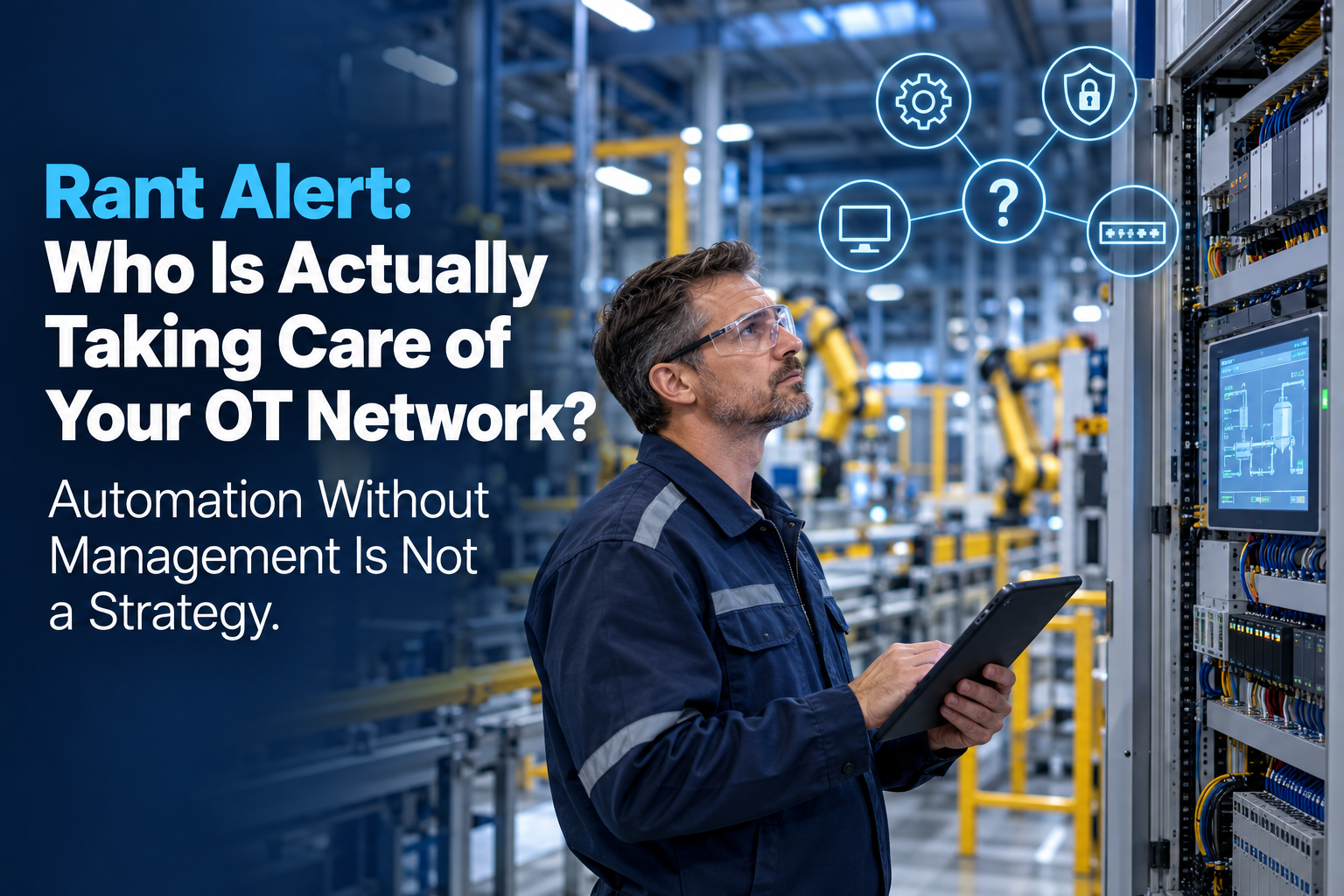
I’ve been spending a lot more time talking to manufacturers about OT networks lately, and I’ve come to a conclusion.
A whole lot of manufacturers have no idea what an OT network is.
Some of you don’t have one. Some of you absolutely have one and don’t know what it’s called. Some of you have a very sophisticated one running a huge part of your operation, yet nobody is actually responsible for maintaining it.
That last one scares the crap out of me.
First, let’s get rid of the tech jargon.
OT stands for Operational Technology.
Your traditional IT network runs the business side of your company. Think email, computers, servers, accounting systems, files, Microsoft 365 and all the stuff your employees use every day.
Your OT network runs or controls physical operation.
Think of production lines, automated equipment, PLCs and HMIs.
A PLC, or Programmable Logic Controller, is basically the computer telling a machine what to do. An HMI, or Human Machine Interface, is what your people use to interact with that equipment.
Not every manufacturer has the same level of OT. That’s important.
Some manufacturers are still highly manual. People are doing most of the work, with very little automation involved.
Others are a combination of manual and automated. People are still heavily involved in production, but automated equipment and systems are helping run pieces of the process.
Then you have highly automated facilities where someone can sit in a control room and run entire production lines through technology.
Those are three VERY different environments with very different risks.
Here’s where my rant starts.
Who is taking care of all this technology after the automation project is finished?
A manufacturer decides to automate something. They bring in an automation company or systems integrator. The project is designed. Equipment has been installed. Everything gets configured. It works, and then everyone celebrates and the project is complete. Then the people who installed it move on to the next project. That is where I start asking questions nobody seems to want to ask.
Who will monitor it tomorrow?
Who will maintain it next year?
Who patches it?
Who knows what devices are connected to it?
Who is checking whether something is starting to fail?
Who owns the network?
Who is responsible for cybersecurity?
Who is managing the darn thing?
The answer seems to be nobody.
These automation environments can have Windows-based systems running inside them. I’m finding Windows 10 in manufacturing environments even as the rest of the business is moving forward. Patches may be available, but that doesn’t magically mean somebody is testing, approving and installing them. That distinction matters. You cannot treat a production environment exactly like Abby’s laptop in accounting. You also cannot decide that means you should never touch it again. Neither answer is a strategy.
Then there’s network isolation. Your OT environment generally should not just be hanging out wide open with your regular business network like everybody is at the same neighborhood barbecue. These environments need to be intentionally segmented and protected. Yet not every manufacturer has done that. Worse, some don’t even know whether they’ve done it or your reading this right now breaking out in a sweat.
Think about that for a second.
You may have technology controlling the equipment responsible for making your product, but you don’t know how that technology connects to the rest of your company.
That is a business risk, not an IT problem.
This is also why manufacturers need to stop assuming that having an IT provider means somebody is automatically taking care of OT. From my seat most MSP’s are general and take care of everybody which means they average at best. There is a bunch that service manufactures and don’t even know about the OT risks or problems.
Your MSP might be managing your traditional IT environment beautifully. Your automation vendor might have built an amazing production system.
Great.
Who owns the space in between?
Who is monitoring the OT network? Who is maintaining it? Who is documenting it? Who is checking its health? Who is coordinating with the automation vendors? Who is thinking about security? Who has the plan when something stops working?
Please don’t tell me, “We call the guy who installed it.” That is break-fix wearing a manufacturing hat.
You wouldn’t build a multimillion-dollar production line, never perform maintenance on it and assume everything will be fine forever. Well, I can’t say that. If that’s you happy to walk through next steps and what you should be thinking about.
Why would we do that with technology controlling it?
This is why one of the first questions I think every manufacturer should be asked is incredibly simple:
How automated are you?
Are you highly manual? Are you a combination of manual and automated? Are you highly automated?
Once I know that, my next questions completely change.
If you’re automated, who built the environment? Who supports it today? Who performs ongoing maintenance? Who monitors it? How is it segmented from your corporate network? What operating systems are running inside it? Who handles patching? What happens when something fails? How quickly can you recover?
I don’t need the plant owner to become an OT engineer.
In fact, PLEASE don’t. You have a business to run. I want you to understand enough to ask the right questions and know who owns the answers.
Technology should make manufacturing better. Automation can create incredible efficiency, consistency and scale. That doesn’t mean you install it, walk away and hope like hell it keeps running.
Automation without ongoing management is not a strategy.
Know what you have, who owns it, maintains it, and how it’s protected.
Then add one more. Know what happens when it fails.
If nobody can answer those questions, you just found an important problem to solve.
Request an IT assessment, schedule a consultation, or contact Blue Net to learn how specialized IT support can help your business operate securely and efficiently.

Recent Posts


How can we help?
Whether you need immediate help with an IT issue or want to discuss your long-term IT strategy, our team is here to help.
Call us at (952) 900-3832 or complete the form below and we'll help in any way we can.